
How many clichés can one technology collect? From comic books to boardrooms, a few lines about AI get repeated so often they've become slogans.
“With great power there must also come great responsibility!”
Stan Lee, Amazing Fantasy #15, 1962
“The development of full artificial intelligence could spell the end of the human race.”
Stephen Hawking, BBC interview, December 2014
“AI is the new electricity.”
Andrew Ng, Stanford Graduate School of Business, 2017
“AI won't replace humans, but humans with AI will replace humans without AI.”
Karim Lakhani, Harvard Business Review, 2023
Behind the clichés is a real question for anyone running a project, a website or a business: what can AI actually do for you, and what does it take to get those results safely?
Huang is partly right. AI has lowered the barrier to entry for nearly every creative and technical task. But lowering the barrier to starting is not the same as lowering the barrier to finishing well.
Reality check
What AI really is (and isn't)
Contrary to popular belief, today's “artificial intelligence” is not intelligent in the way people are. A large language model is a prediction system. It's trained on huge amounts of text, code, images and video, and it generates the content most likely to come next. It can be astonishingly fluent, but it does not think or reason the way people do.
That magic is real enough to be useful, and convincing enough to be misleading. Mustafa Suleyman, CEO of Microsoft AI, put the tension well:
A simple experiment
The car wash test
Try giving an AI a simple problem:
The prompt
“I want to wash my car. The car wash is 50 meters away. Should I walk or drive?”
131
AI models tested
31
said drive, for the right reason
90
said walk
Source: The Car Wash Test, AI common-sense reasoning benchmark, February 2026.
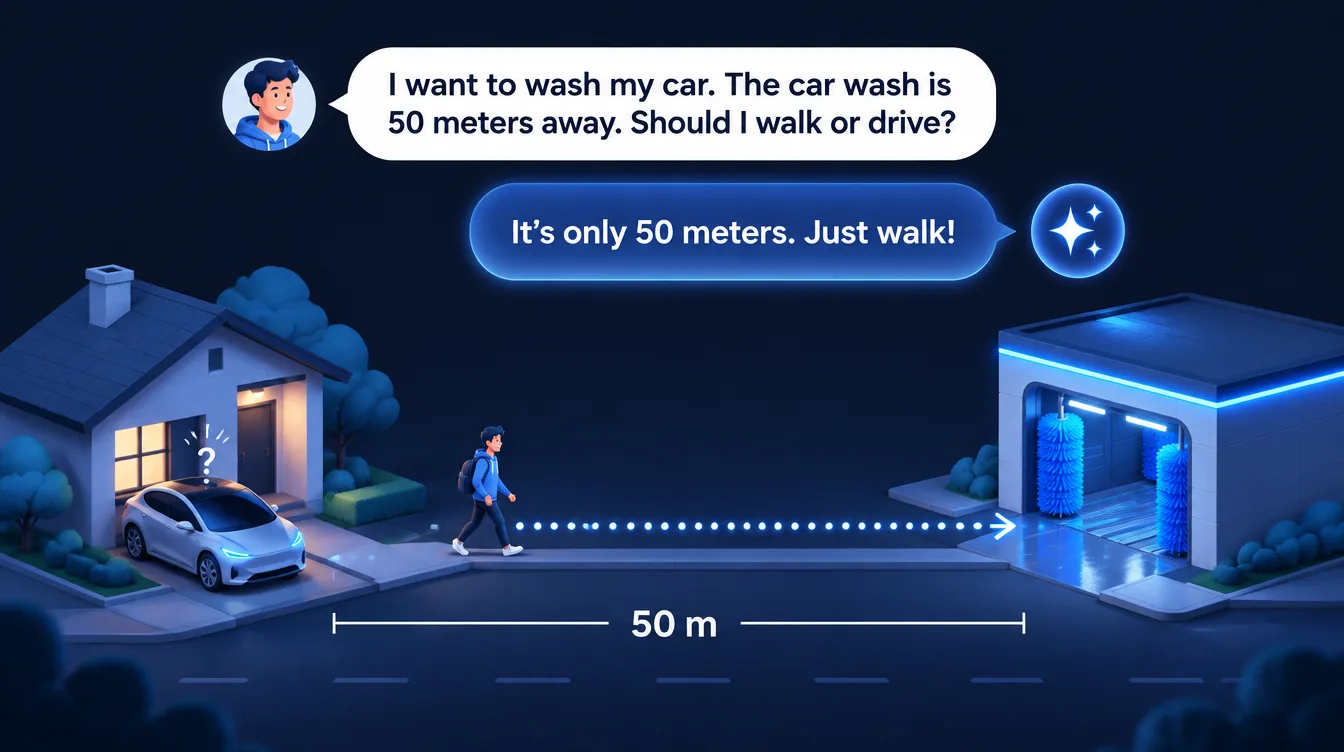
The car is the thing that has to make the trip. Most AI models missed that.
Any person sees the answer at once: you have to drive, because the car needs to be at the car wash. Yet in a 2026 benchmark of 131 AI models, only 31 answered correctly for the right reason. Ninety confidently recommended walking. They latched onto “50 meters is so close” and missed that the car itself is the thing that has to travel.
The lesson isn't that AI is useless. It's that AI follows patterns, not purpose. It gives the answer that sounds right. Telling that apart from the answer that is right still takes a person who understands the problem.
Speed in the right hands
A power tool for experts
AI models improve every month, but they still need people to guide them. What they offer is speed and raw power, and in the right hands that means a big boost in productivity. A nail gun doesn't make anyone into a carpenter, but it makes a skilled carpenter much faster.
The hidden risk
Where do-it-yourself AI goes wrong
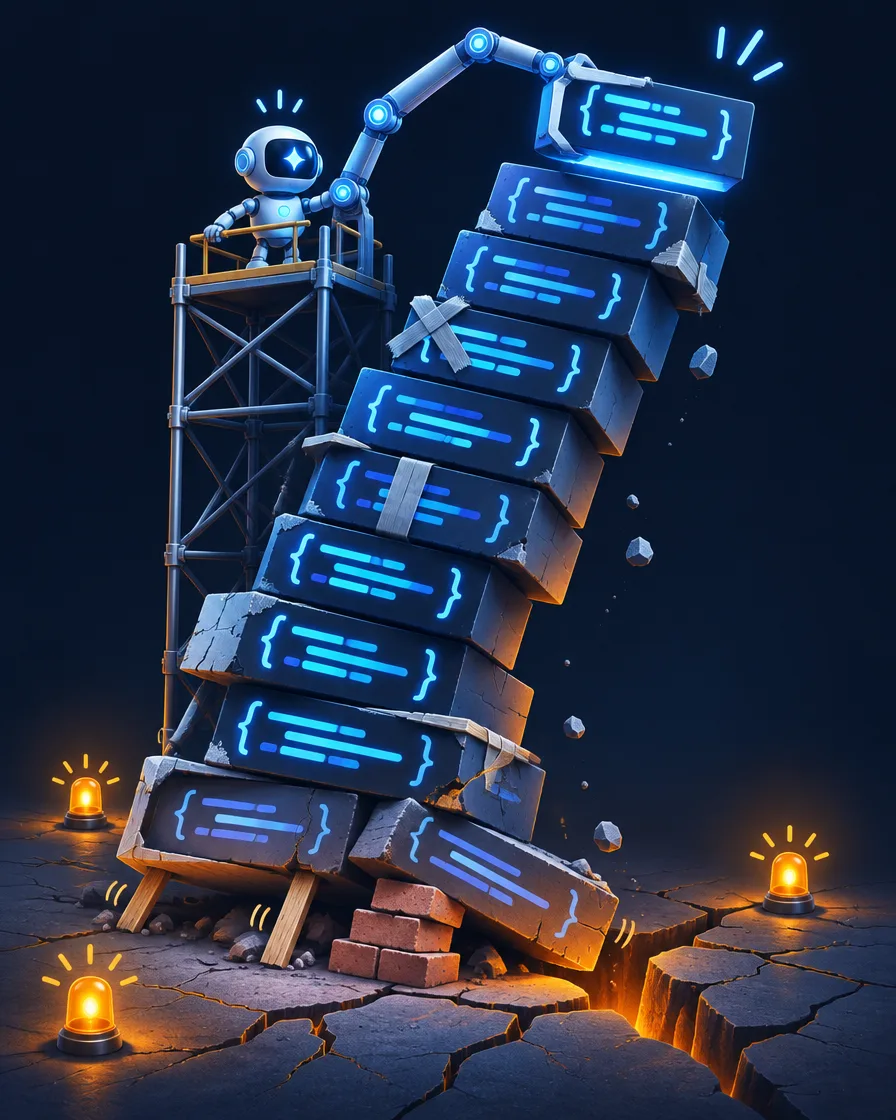
Build on a shaky foundation, and every new layer makes it lean further.
When a non-expert uses AI to build an app, the early results come quickly, and they can get surprisingly far. Screens appear in minutes, features work, and progress feels fast. But without a strong foundation, the AI rarely produces an architecture that can scale, stay secure, or actually launch.
The speed doesn't last, either. AI is at its best on small, self-contained pieces of code. As an application grows, every change touches more files and more hidden connections than the model can keep in view at once. Progress slows, each fix takes more attempts, and changes in one place quietly break something somewhere else.
Worse, AI tends to pile new code on top of shaky code. Every fix adds another layer. Eventually the codebase becomes so tangled that it collapses under its own weight, and the AI that built it can't dig itself out.
See how we rescued an unfinished AI-assisted rewrite →Generating code that runs isn't the hard part. Building something people can understand, maintain and grow is.
Our approach
This is where Tecture comes in
Tecture's developers know how to use AI to speed up development while keeping firm control of your project's architecture. AI does its best work when its raw power is matched with expert skill and oversight. Sound engineering, thoughtful architecture and real-world experience let you get the most from it, safely and effectively.
We use AI the way a master craftsperson uses a power tool: deliberately, for the right job, with an expert eye on every cut.


